AI that guides data teams from signal to decision
I designed a context-aware AI system that helps data engineers know what to do next during an investigation, turning a complex workflow into guided decision-making.
- Product
- Actian Data Observability
- My role
- UX Intern
- Timeline
- Jun–Aug 2025 · 12 weeks
- Team
- JEKRJF+1
AI existed. It just didn't help when it mattered.
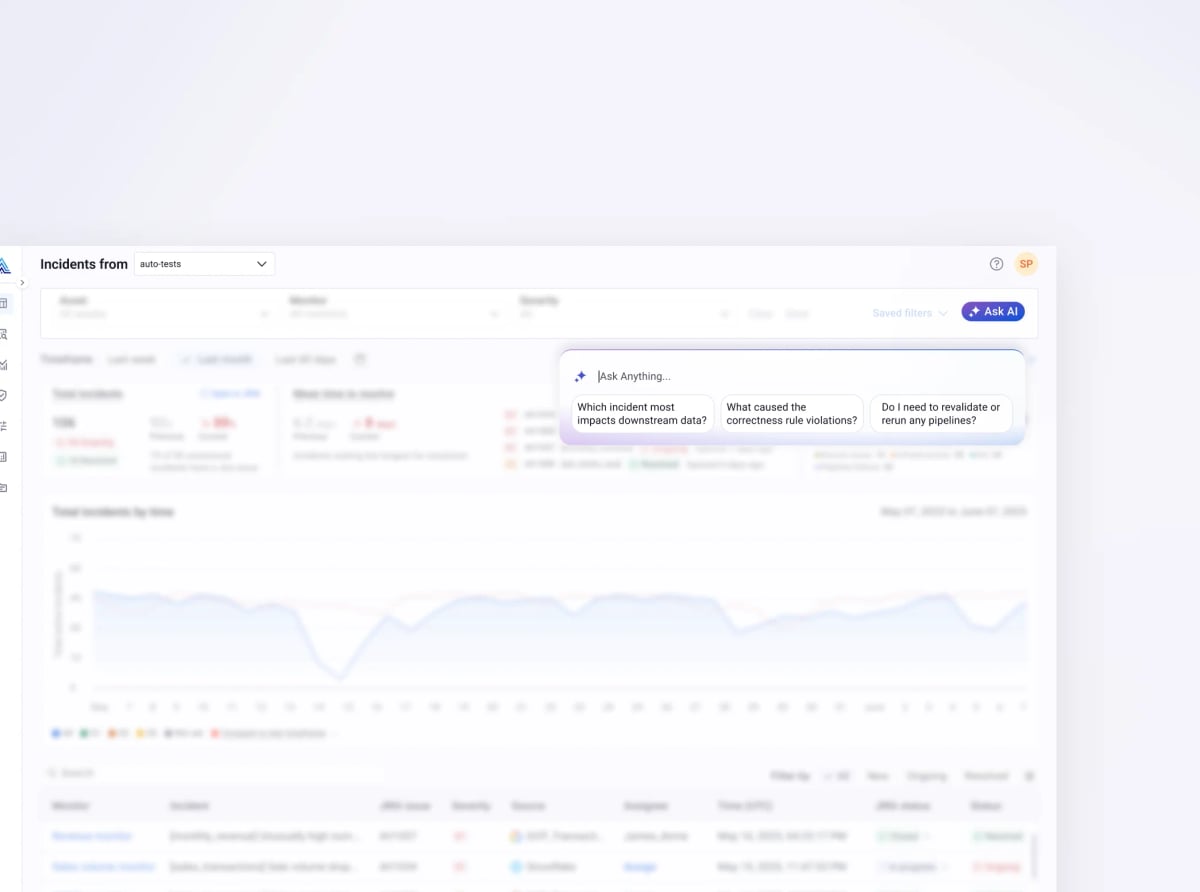
Actian's Observability Platform helps data teams catch and fix issues across large systems. During its 2025 launch, I had twelve weeks to define how AI should show up here: part of the workflow, not bolted on.
The problem
Guidance gap
Engineers had every signal. What they lacked was knowing what to do next.
The solution
Context-aware AI
AI surfaces inline, scoped to what someone is already investigating.
What I delivered
AI system
A reusable AI component library and a foundation for future AI features.
Key outcome
~25%
Measured by the team. Clearer guidance got new engineers to a confident first action sooner.
1 / 3
Users had data. They didn't know what to do next.
During a live incident, engineers have every dashboard and log they need. After each step they still get stuck on one question: what do I look at next?
For the user
More time guessing. Less confidence in each decision. Every manual step adds pressure and slows the resolution.
For the product
Slower resolution means unreliable data reaching clients. For a platform built on trust, that is the worst outcome.
What makes AI actually useful.
I reviewed twelve AI tools, studying how people start with AI, how systems respond, and what builds or breaks trust.
The platforms that felt most useful were not the most capable. They were the ones where AI responded to what people were already doing.
Old question
How do we make AI easier to find?
Real question
How do we help people know what to do next, in the moment they need it?
Key insight. Access wasn't the issue. Knowing what to do next was.
What the model could not do.
I prototyped in code with the AI dev team, so I designed to what the model could actually do.
The decision
Silence became part of the design. The system speaks only where it has something grounded to say. It promised only what could ship.
NDA · Protected work
The rest of this case study is protected. 6 chapters are under NDA.
What's above covers the problem and the reframe. What's protected covers the design work: personas, explorations, and what shipped.
The password is on the resume you received from me.
Don't have it? Email me and I'll reply the same day.
Inside
- 01UsersThe primary persona: who investigates, what they reach for, and the moment they get stuck.
- 02ExplorationThree AI participation models, and why two of them broke the workflow.
- 03The solutionThe three-stage flow, walked screen by screen.
- 04FeaturesThe feature set, each mapped to a moment of uncertainty.
- 05Delivery & impactThe component library, handoff artifacts, and what the numbers held up.
- 06ReflectionWhat I would defend, and what I would do differently.